
Mark’s Score 8.9

When I talk about the joys of small-town museums, this is the museum that is in my mind’s eye. I visited this museum for the first time about a decade ago. I have been back several times since, but it has been closed for over a year and just recently reopened. I took their re-opening as an opportunity to revisit this museum.
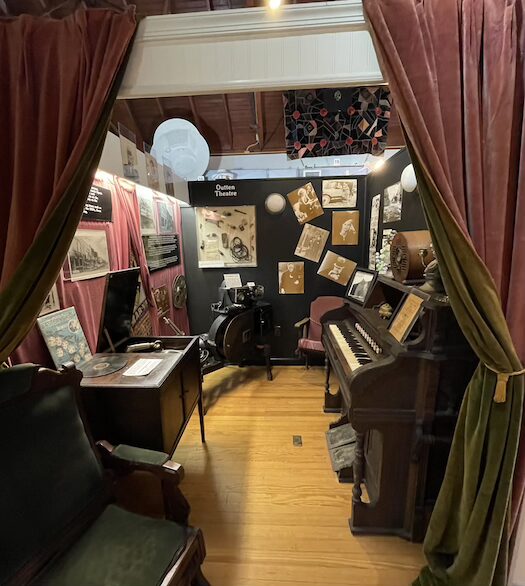
The Purnell Museum is housed in the former St Agnes Catholic Church located on West Market Street. St Agnes closed a few years after opening at the turn of the 20th century. In 1957 the building became the Julia A. Purnell Museum. Julia Purnell was a life-long resident of Snow Hill for more than 100 years. She was famous for her needlepoint, and passed away in the early 1920s. Her needlepoint work is displayed in the museum, the display includes a handwritten letter from Eleanor Roosevelt recognizing Purnell’s work.
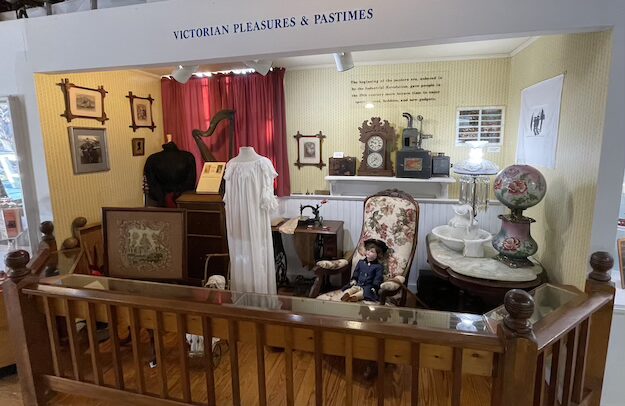
At first glance the museum appears to be a collection of disjointed bric-a-brac. But when put all together it tells a story about the lives of the people who came before us, beginning with Julia Purnell. She was just a small-town girl who lived an ordinary life. But she had a deep and fierce love and loyalty for her community. So much so upon her death she left a lifetime of collected items to the town to be housed in a museum. Given her long life, her life’s story goes all the way back to the early American Republic. Jefferson and Adams were still alive when she was born.
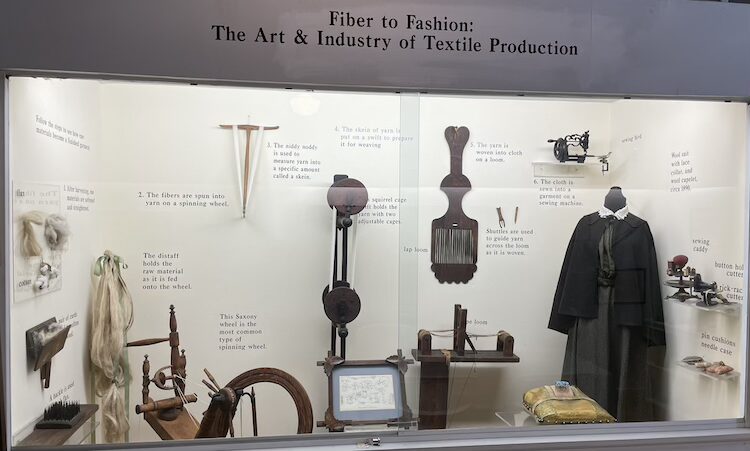
In addition to her needlework there is also a display of items to be found in a typical kitchen in the Victorian Era. One display contains memorabilia from the Civil War, including some old Confederate currency. There is an oddball display of children’s toys and a display of “Victorian Pleasures and Pastimes.” There is also a display of home textile production tools, demonstrating how people hand-made thread and clothing from wool and cotton.
But I think my favorite item was the whistle from the SS Morro Castle. The SS Morro Castle was a passenger vessel sailing from Havana to New York when it caught fire off the coast of Asbury Park, NJ in 1934. It crashed on to the beach in front of the Paramount Theater, and 137 people lost their lives. Consequently, both the beach and the theater are said to be haunted by the Morro dead. The whistle ended up at the Purnell because a local company bought the whistle and donated it to the museum. It seems incongruous, but when you think about it, perhaps it is appropriate that the whistle ended up in a museum that is surrounded by Maryland’s most famous haunted forest.
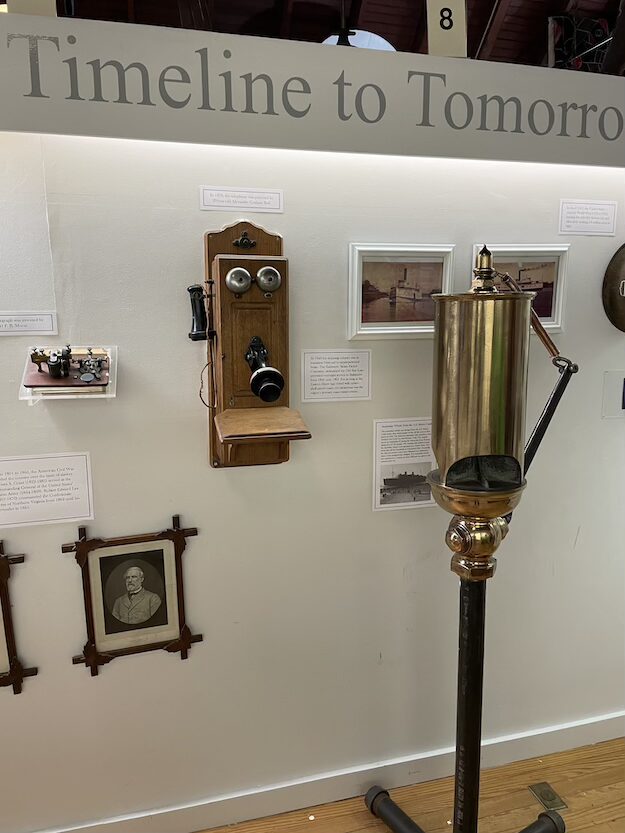
The Morro story explains why I love small-town museums and why they are important. The disjointed events of the past come together to form an historical cohesive tableau of life in Snow Hill. Our lives are delightfully incongruous and disjointed, so too are museums that tell our tales.
What else is there to do in Snow Hill?
Don’t want to miss any of my posts? You can follow me on my Facebook Page.
Leave a Reply